
How to Check Criminal History in Plano
Choose the Plano record holder by the event, not by a broad phrase such as background check. The city police department holds reports created by its officers. Plano Municipal Court holds fine-only city and traffic cases. A custodial arrest may also create a Collin County jail entry, and a prosecutor may file a separate case with a county clerk. Texas DPS maintains a different state record built from reported arrest cycles and outcomes.
- Begin with the Plano Police transparency hub when the event involved a Plano officer, call for service, or incident report.
- Submit a precise police open-record request with the report number, date, place, and involved names when known.
- Use Plano Municipal Court for a city citation, ordinance matter, traffic case, plea, setting, or fine-only judgment.
- Check Collin County jail and court channels if the event led to booking or a Class A or B misdemeanor or felony filing.
- Use Texas DPS for its statewide public conviction and deferred-adjudication product, or fingerprint review for your own fuller Texas record.
No-result screens require care. A spelling variant, reporting delay, restricted record, form failure, or a case filed in another county can all explain an empty search.
Plano Criminal Records Transparency Hub
The Plano Police transparency hub brings several official resources into one city page. It connects a requester to open-record requests, calls for service, annual reports, crime statistics, news releases, custodial-death reports, use-of-force review, racial-profiling reports, and officer-involved-shooting material. Those resources do not all describe the same thing. A call for service shows demand for police response. An incident report records a specific response. A county criminal case shows what prosecutors later filed.
The official Plano transparency hub is also the source for this view of Plano police record tools:
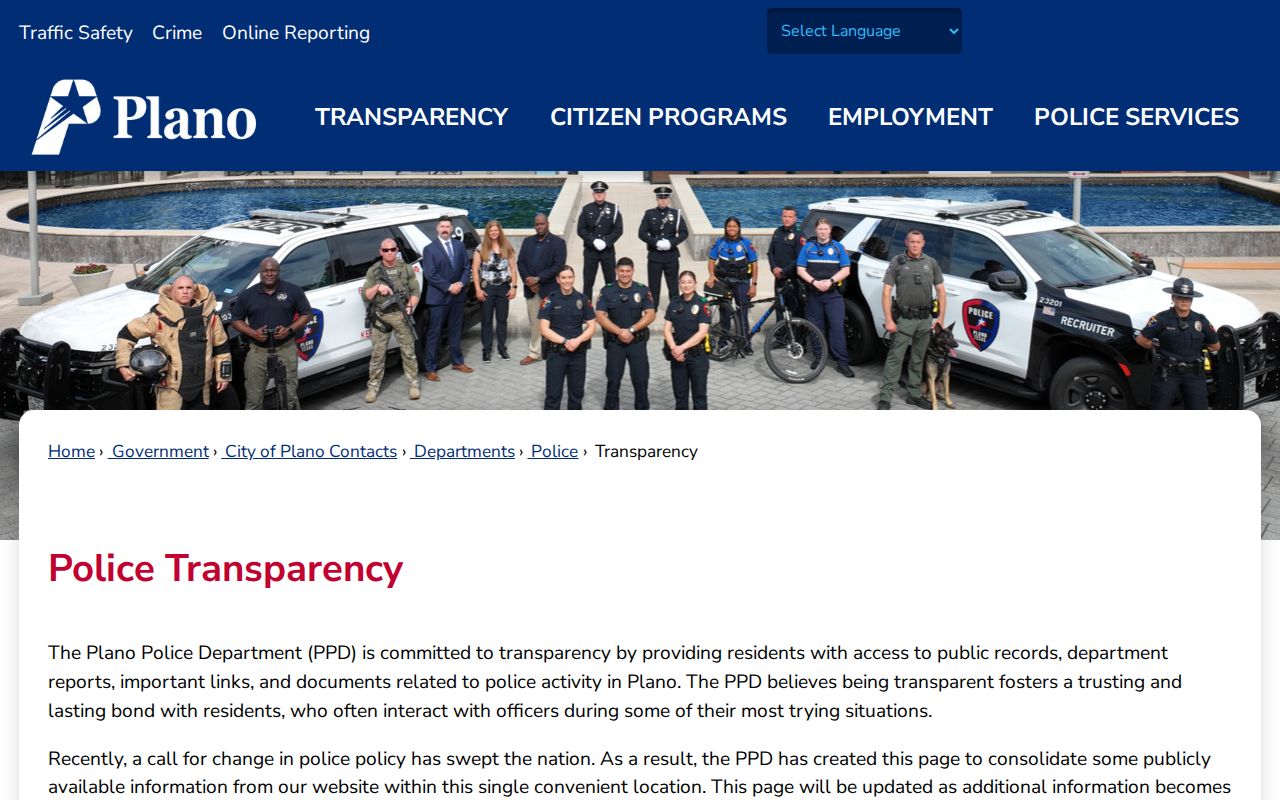
The image reinforces why a Plano search should start with the product that matches the question instead of treating every police data set as an arrest record.
The Plano Police Department
Plano Police is the custodian for incident, offense, arrest, and related law-enforcement records its staff creates. Collin County's public-information office does not take custody merely because the event happened inside the county. The city's police request route commonly asks for requester contact information, an incident or report number if known, date, time, location, involved parties, a clear description, desired delivery method, and any useful file upload. The live form controls which fields are required.
Describe an existing Plano record. A written Plano request is not a demand for legal advice, a new report, or research across unnamed files. Tight identifiers reduce the risk of a slow or overbroad Plano search. Some Plano material can be withheld or redacted when it concerns an active investigation, a protected victim, a juvenile, medical facts, confidential sources, or protected identifying data.
Plano Calls Versus Arrest Records
Plano calls-for-service data and Plano arrest records answer separate questions. A dispatched call can close without an arrest. An arrest report, by contrast, describes the asserted legal basis for custody. A later booking record tracks jail intake, while the court file records the charge that prosecutors chose to file and the result.
| Plano source | What it can show | What it cannot prove |
|---|---|---|
| Calls for service | Police demand, location, and response activity | That an arrest or charge occurred |
| Police incident or arrest report | The officer's event record and alleged basis | A filed charge or conviction |
| County booking entry | Custody, booking charge, bond, and release data | The final court outcome |
This split matters when two Plano records appear to conflict. Police may classify conduct one way at the scene, prosecutors may refile it, and a court may dispose of a different filed charge.
Arrests and Bookings in Plano
Plano does not replace the county jail search for adult county custody. After a qualifying Plano arrest, the police report stays with Plano Police, while booking data may appear in the Collin inmate roster and the county Arrests and Releases Report. The roster covers current custody and releases from the past 24 hours. The separate report reaches back up to one week. Neither source is a permanent arrest archive.
If a prosecutor files a Plano charge, the court trail becomes the next source. A Class A or B misdemeanor goes to a Collin County Court at Law, and a Plano felony goes to District Court. A booking label is provisional and is not proof of guilt. The official Collin inmate information page routes current county custody searches. For a deeper treatment of custody sources and their time windows, use the contextual Collin County arrest history resource.
Note: Release from the roster can mean transfer or release from county custody, not that every criminal matter has ended.
Finding Plano Criminal Court Records
Start with the Plano citation, report, bond paper, or release sheet. Its court name and case number are stronger routing clues than a mailing address. Fine-only Plano matters belong with the municipal court. County-filed Plano misdemeanors belong with the County Clerk, and felonies belong with the District Clerk. The Collin case-information page compares the county Justice System App, Case Search, and Case Record Inquiry. The tools have different update schedules and historical coverage, so a Plano search may need more than one county interface.
Plano also sits near the county's southern edge. Most city activity is associated with Collin County, but a small part extends into Denton County. Confirm the filing county rather than assuming that every Plano address creates a Collin case. The arresting agency, court name, county jail, and case number settle the route more reliably than ZIP code alone.
Plano Municipal Court Records
Plano Municipal Court handles city ordinances, traffic matters, and fine-only Class C misdemeanors within its jurisdiction. Its record may contain a citation number, alleged offense, plea, settings, judgment, and compliance or payment status. It does not hold a District Clerk felony file or a County Court at Law Class A or B misdemeanor case.
The official Plano Municipal Court records page is the intended city route. During research, its embedded request form displayed an error. That form state is a reason to use the court's official contact route, not evidence that no municipal record exists.
| Court Name | Plano Municipal Court |
|---|---|
| Case Types Heard | City ordinances, traffic matters, and fine-only Class C misdemeanors |
| Case Lookup Channel | Official municipal record-request page, with direct court contact as the fallback when the form fails |
| What the Docket Shows | Citation, alleged offense, plea, settings, judgment, and compliance or payment status when applicable |
| County Boundary | Class A and B misdemeanors and felonies are held by the appropriate county clerk, not this court |
When Plano Record Forms Fail
A loading error is a channel problem, not a record result. Save the page address, note the time and error text, and try the official control once. If it still fails, contact the relevant Plano records unit or court through its official city page. Include the exact record type, name, date, place, and report, citation, or case number. Ask for inspection or an estimate when the request may include a large file or media.
Keep the request tied to existing documents. For a police event, use the police records channel. For a municipal citation, use the court clerk. If the case was filed at county level, switch to the proper Collin clerk rather than repeatedly submitting the city form. This fallback chain preserves a traceable request and prevents a portal fault from becoming a false no-record conclusion.
The official Plano municipal request interface looked like this during source capture:
The captured city page supports direct verification of the Plano court route even when an embedded control is temporarily unavailable.
Where Plano Records End Up
One Plano event can produce several records with different owners. Police retain their report. The county sheriff holds booking and custody data if the person enters the Collin jail. A county clerk holds any filed Class A or B misdemeanor or felony case. Clerks then report qualifying dispositions to the Texas Department of Public Safety Crime Records Division.
Record flow: Plano Police Department › Collin County Courts › Texas Department of Public Safety
The state public Crime Records Service is a conviction and deferred-adjudication name product, not a full Plano police-report search or complete Plano court index. Fingerprint-based DPS personal review is the better Texas channel for reviewing your own identity-linked state record. These Plano layers can update at different times.
Three Plano Criminal Record Layers
A city report, county case, and state criminal-history entry should not be treated as duplicate copies. The Plano report is richest about the initial response and observations. The county court file is richest about filed allegations, hearings, attorneys, orders, judgment, sentence, and costs. The DPS history connects fingerprint-linked arrest cycles with outcomes reported to the state, but its public product shows only the subset authorized for public release.
- Incident report
- The Plano officer's record of a reported event and response.
- Booking record
- The county jail's intake and custody record after an arrest.
- Disposition
- The court's recorded result for a filed charge.
- Criminal-history record
- The DPS identity-linked compilation of reported arrest cycles and outcomes.
When accuracy matters, compare Plano identifiers and event dates across the sources. A Plano report number should align with the police event, while a county case number identifies the filed prosecution. Search exact names first, then check a known alias or corrected spelling. Allow for the county portal's update schedule after a new Plano filing. Do not use an empty Plano portal result as proof that no other layer exists.
Plano Records at Park Boulevard
Constable Precinct 3 is an independent county law-enforcement office at 920 E. Park Boulevard in Plano. It may create records tied to warrant, civil-process, or enforcement duties. Its published county directory number is 972-881-3070. The address also appears on Collin's expunction contact material, which is useful because clearing a qualifying record can involve more than a police department and court clerk.
Collin CSCD also publishes a Plano office line, 972-881-3030, for its county-run community-supervision work. Operational probation information is not a general public search product. These city-located county offices illustrate a key point: an office can stand in Plano while its records belong to a county function.
Public Access Rules
Plano Police requests fall under the Texas Public Information Act, subject to its exceptions. Court case records are judicial records and follow court rules, common law, and statutes rather than the ordinary public-information route. Access can be restricted for active law-enforcement interests, protected victims, juveniles, motor-vehicle data, confidential sources, medical information, and records affected by expunction or nondisclosure.
Key Statutes:
Texas Government Code Chapter 552 provides public access to government information while preserving stated exceptions and basic arrest information.
Texas Government Code Chapter 411 governs criminal-history dissemination and orders of nondisclosure.
Texas Code of Criminal Procedure Chapter 55A governs expunction of qualifying records.
A dismissal does not itself erase the Plano police and booking trail. An eligible Plano petitioner needs the remedy that fits the case, and an order must reach each Plano, county, or state agency that actually holds a related record.