
How to Check Criminal History in Frisco
Start from a Frisco report, citation, bond paper, or release sheet if one exists. The agency name, event location, court, county, and case number identify the correct path far better than a city mailing address. Frisco Police and Municipal Court are citywide custodians, but county detention and prosecution depend on where the event belongs.
- Use the Frisco Police written public-information route for a report created by a Frisco officer.
- Give the date, place, involved names, and report or incident number, and provide at least two contact methods when possible.
- Use Frisco eCourt or the municipal record form for a city citation, traffic matter, ordinance case, or fine-only misdemeanor.
- Confirm whether a booking or filed county charge went to Collin County or Denton County, then search that county's official system.
- Use Texas DPS for its statewide conviction and deferred-adjudication product or fingerprint review of your own state history.
A no-result screen is limited by spelling, date coverage, filing delay, confidentiality, and jurisdiction. It never proves that no other Frisco record exists.
Frisco Criminal Records Require Writing
Frisco Police requires a written request for police records. The official Frisco public-information page provides police-specific online routes and states that other law-enforcement or corrections agencies may submit directly by email or fax. The published fax number is 972-292-6075. Frisco recommends giving at least two ways to contact the requester.
A useful written request names an existing record and supplies the incident number, date, time, location, involved parties, and precise material sought. Open-ended questions or demands that staff create an explanation are not requests for an existing public record. The official Frisco request source appears here:
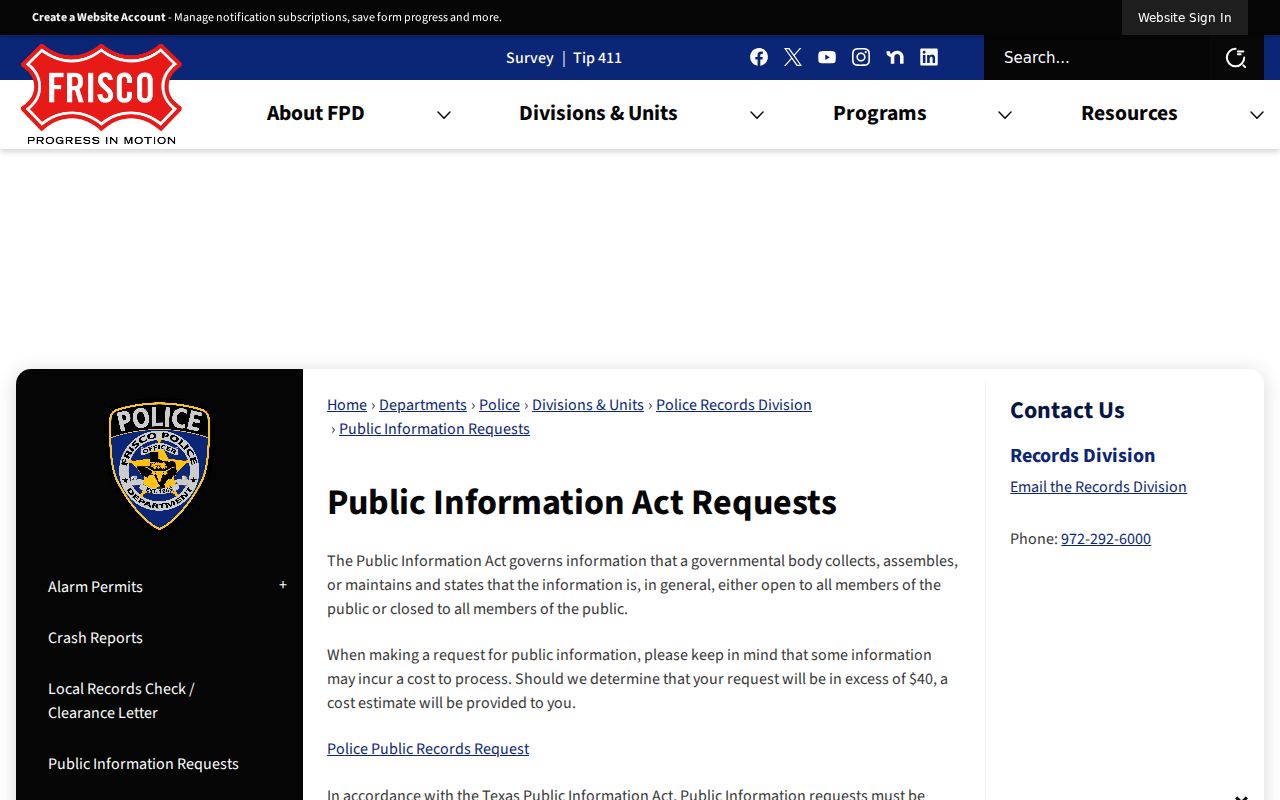
The captured page confirms the city route and helps separate Frisco Police records from county clerk or jail requests.
The Frisco Police Department
Frisco Police Headquarters is at 7200 Stonebrook Parkway, Frisco, Texas 75034. The department's published main number is 972-292-6000. Police reports created by Frisco officers remain with the city even when a later booking or prosecution belongs to Collin or Denton County. That distinction is critical in a city that crosses the county line.
The department says it searches and responds within three to five business days, including when no responsive record is found. That is a stated search and response period, not a promise that every releasable copy arrives within the same window. Protected victim information, juvenile data, active-investigation details, medical facts, and other confidential content may require review or redaction.
The official Frisco Police page provides this image of the Frisco police setting:
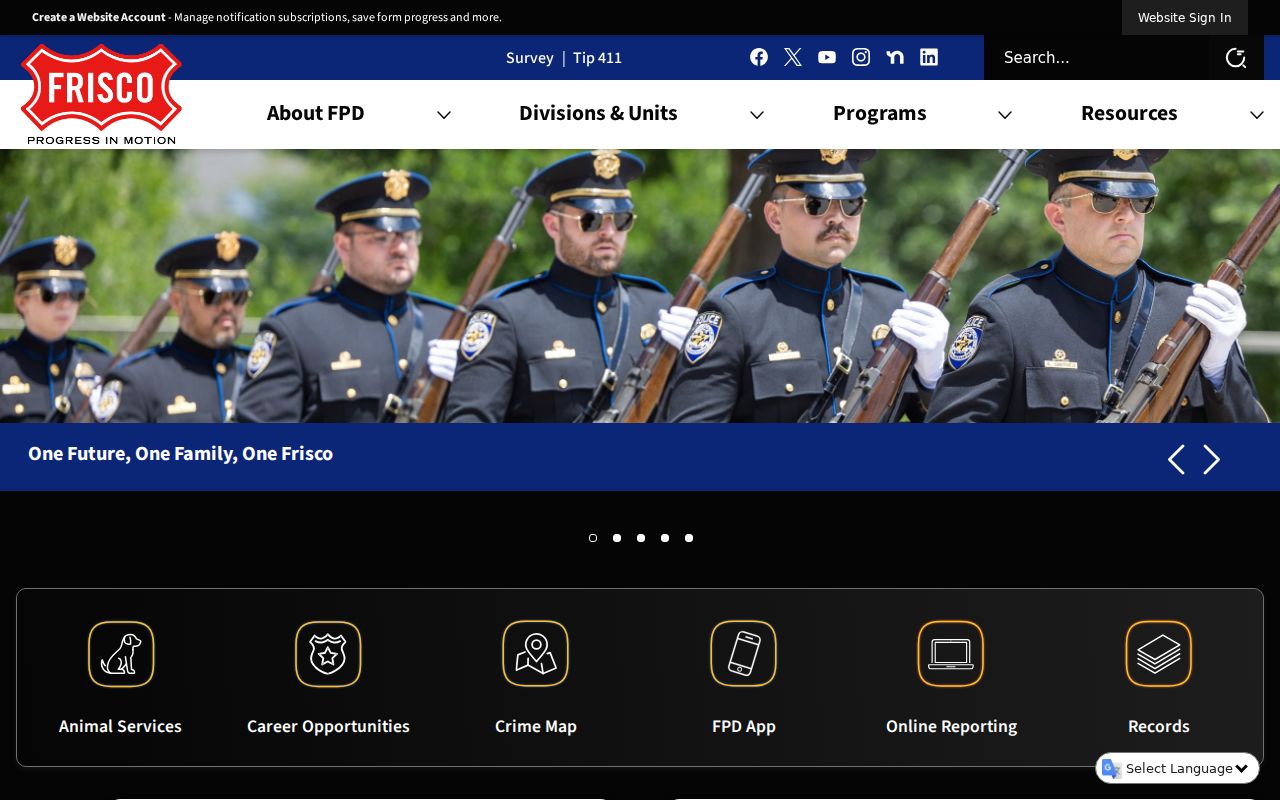
Stonebrook Parkway is the city anchor for police-created material, not the filing office for every county prosecution arising in Frisco.
Frisco Record Timing and Cost
Frisco's three-to-five-business-day statement is a practical request benchmark. The department says it sends a response even when its search finds no record. Keep that response with the original search terms. If a name, date, or incident number was wrong, a corrected request may produce a different result.
A request projected to cost more than $40 triggers an estimate. That threshold does not mean every Frisco police report costs $40, nor does it set a flat city fee. Scope, media, staff review, and permitted charges can affect an estimate. Ask for inspection or narrow the date range before ordering a large group of records. Do not mix this police rule with municipal court certification fees or county sheriff fees, which are separate schedules.
Arrests and Bookings in Frisco
A Frisco arrest report remains with Frisco Police. Custody can be different. Depending on the event location and agency routing, the person may enter a Collin County or Denton County jail. The resulting prosecution can likewise be filed in the county with jurisdiction. A Frisco address alone does not settle either question.
For a Collin event, use the official Collin inmate information page for current custody and releases within 24 hours, and use the Arrests and Releases Report for a window reaching back up to one week. Then follow the county case system after prosecutors file. For a Denton event, use Denton County's official jail and clerk channels. The police report, bond paper, or citation should identify the county.
Note: An arrest or booking charge is an allegation at that stage, not proof of guilt or the final charge filed in court.
Frisco Records Cross County Lines
Frisco substantially spans Collin and Denton Counties. A city police record stays with Frisco Police because the department created it. County records follow jurisdiction. This means one event may have a city report and a Collin County case, while another Frisco event may have a city report and a Denton County case.
| Clue | What it identifies | Why it matters |
|---|---|---|
| Agency name | The police custodian | Routes the incident or arrest report |
| Event location | Likely county jurisdiction | Helps locate jail and prosecution records |
| Court name | The clerk holding the case | Separates city and county filings |
| Jail or booking number | The custody system | Points to Collin or Denton detention records |
When sources disagree, trust the named agency and court over ZIP code. For a Collin filing, the Collin case-information page compares county search tools and update schedules. Boundary location is a routing issue, not proof that any Frisco record is missing.
A report or citation usually holds the best routing clues. Preserve the Frisco Police report number, event place, arresting agency, named court, cause number, and booking identifier. Those details can show whether the next request belongs with a city office, a Collin clerk, or a Denton custodian. If the first county search returns nothing, do not turn that result into a claim that no record exists. Check the document's county and court labels, then use the matching official jail or clerk system.
Frisco Municipal Court Records
Frisco Municipal Court handles traffic matters, city ordinances, and fine-only Class C misdemeanors in its jurisdiction. Its case file can show the citation, alleged offense, plea, settings, judgment, and compliance or payment status. It cannot provide a District Court felony file or a County Court at Law Class A or B misdemeanor case.
The court's eCourt options support citation resolution, document submission, scheduling, attorney access, online record search, and requests. The individual court-record form says judicial records are outside the Texas Public Information Act and may be withheld or redacted under court rules, common law, and statutes.
| Court Name | Frisco Municipal Court |
|---|---|
| Case Types Heard | City ordinances, traffic cases, and fine-only Class C misdemeanors |
| Case Lookup Channel | eCourt search and the individual Court Case Records Request form |
| What the Docket Shows | Citation, offense, plea, settings, judgment, and compliance status when applicable |
| County Boundary | Felony and Class A or B misdemeanor cases go to the correct Collin or Denton County clerk |
Frisco Criminal Records in eCourt
The official Frisco eCourt options page groups several municipal tasks. Use online court-record search when the citation belongs to Frisco Municipal Court. Use document submission or scheduling only for the court process those tools name. County prosecution records remain outside the municipal system.
The official Frisco eCourt source shows the range of court options:
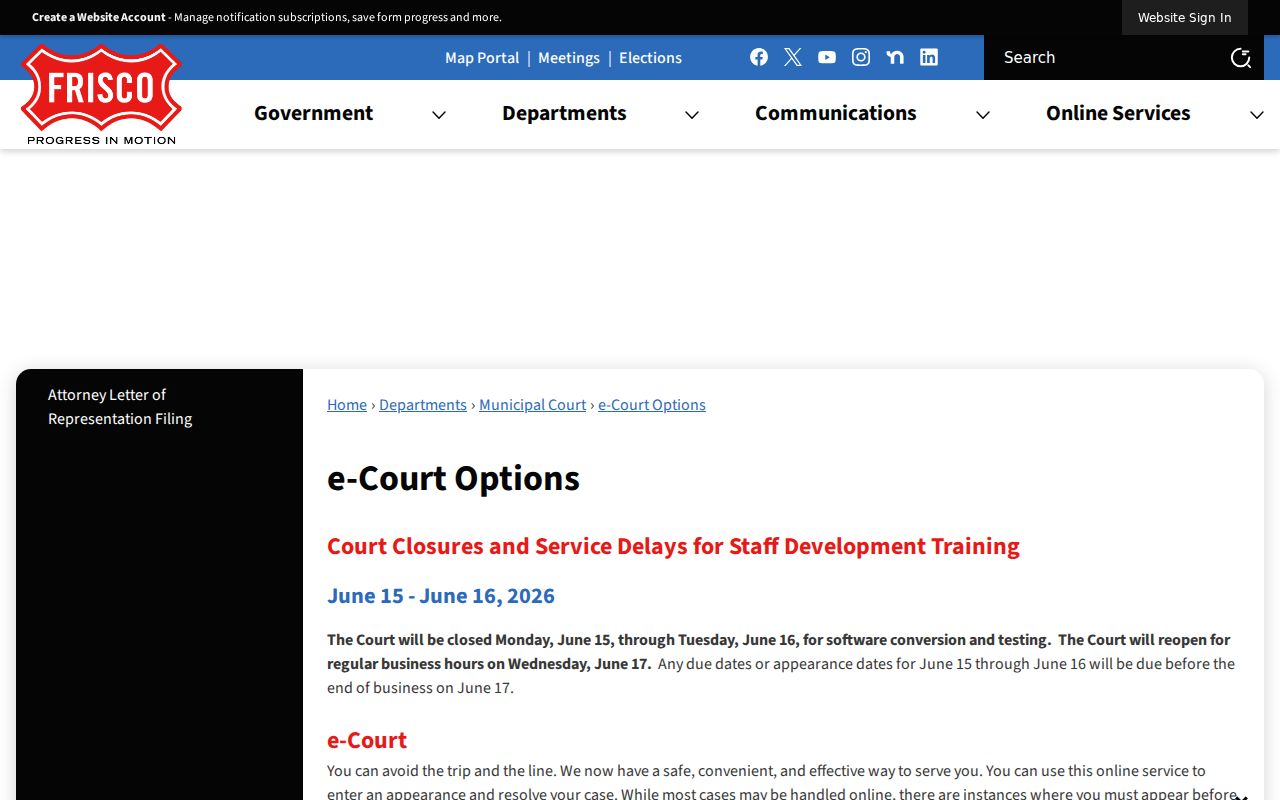
The interface is useful for city citations, yet the visible Frisco label should not be read as countywide criminal-history coverage.
Remote retrieval may take up to 14 days. That notice matters when a document is not available in the immediate online view. Waiting for retrieval or contacting the clerk is the correct response, not concluding that the case does not exist.
Frisco Court Request Choices
The individual Frisco court form gathers requester identity and contact fields, relationship or category, record and case details, and optional supporting uploads such as a notarized release or letter of representation. It also asks whether copies should be certified and how the requester wants to receive them. An email-copy choice is available.
Certification carries a fee. The court contacts the requester, and payment must be made by mail or in person because online payment for certification is unavailable. Bulk requests do not use the individual route. They go in writing to Frisco Municipal Court, Attn: Court Clerk Records Request, 8450 Moore Street, Frisco, Texas 75034.
Remote retrieval may take up to 14 days. That notice is separate from the police department's stated three-to-five-business-day search and response period. It is also separate from the police estimate triggered when projected costs exceed $40. Keeping those three rules apart prevents a requester from applying a police timeline to a judicial record or treating a court certification fee as a police-record charge.
The official Frisco court request form appears in this captured view:
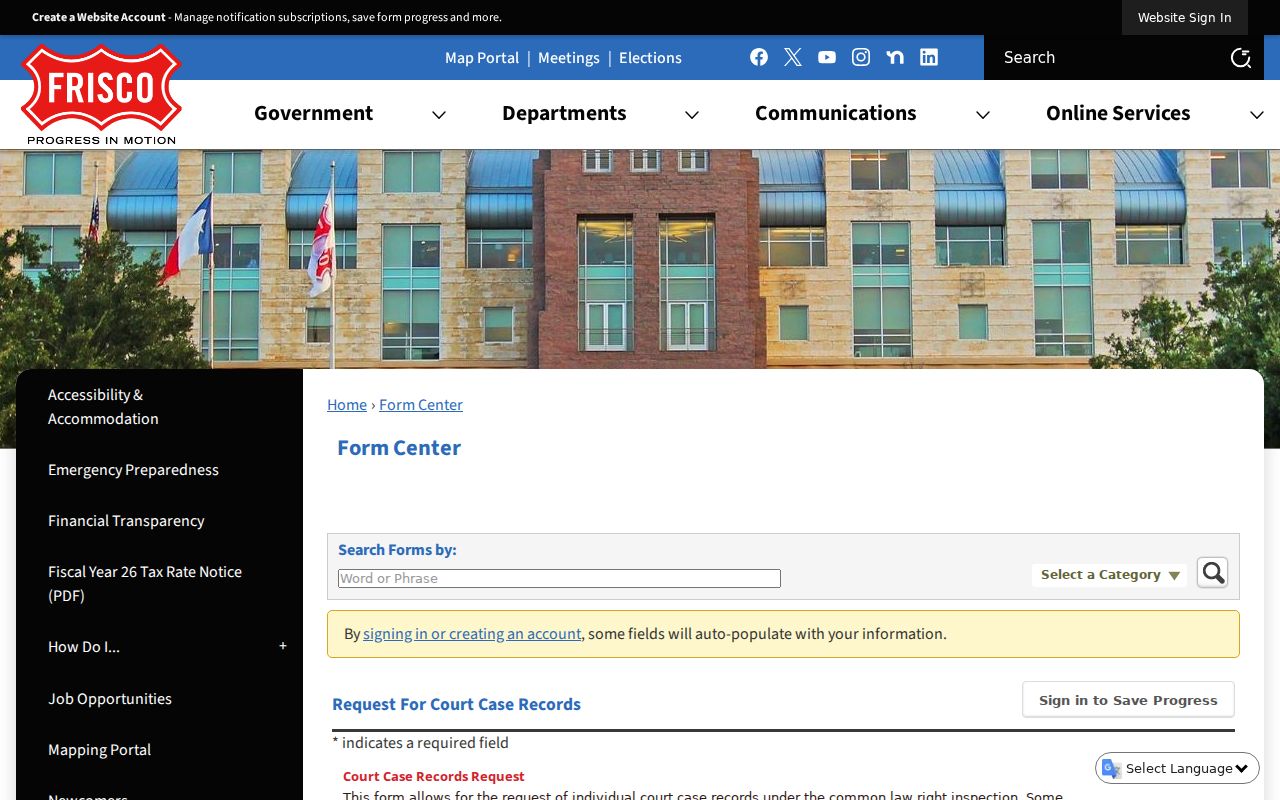
The form's separate certification, delivery, and requestor controls explain why a broad email may not be enough for a precise court-copy order.
Where Frisco Records End Up
Frisco Police keeps the city report. A county sheriff keeps booking data, and a county clerk keeps a filed Class A or B misdemeanor or felony case. Clerks report qualifying dispositions to the Texas Department of Public Safety Crime Records Division. The county portion of the flow must be confirmed for each event.
Record flow: Frisco Police Department › Collin or Denton County Courts › Texas Department of Public Safety
Texas DPS Crime Records Service is a statewide public conviction and deferred-adjudication name search. It is not a complete Frisco incident-report index or a full county docket. DPS fingerprint review is the state channel for reviewing your own identity-based history. County-wide Collin routing is covered in the broader Collin County criminal history overview.
Frisco Citation or Criminal Case
A municipal citation and a county criminal case are not two names for the same file. The citation can identify a fine-only matter heard by Frisco Municipal Court. A county case begins after a prosecutor files a Class A or B misdemeanor or felony with the clerk that has jurisdiction. A custodial arrest can exist before either filing appears.
- Citation number
- The identifying number for a municipal or other cited matter.
- Cause or case number
- The court's identifier for a filed case.
- Booking charge
- The allegation recorded at jail intake, subject to later prosecutorial change.
- Disposition
- The result recorded by the court for the filed charge.
Search each identifier in the system that issued it. A Frisco municipal citation may not be the best key for a Collin or Denton felony docket.
Public Access Rules
Frisco Police records are subject to the Texas Public Information Act and its exceptions. Frisco Municipal Court expressly treats its records as judicial records governed by court rules, common law, and statutes instead. Active investigations, juveniles, protected victims, motor-vehicle information, medical details, confidential sources, and expunged or sealed information may be restricted.
Key Statutes:
Texas Government Code Chapter 552 governs public information and law-enforcement exceptions for city agencies.
Texas Government Code Chapter 411 regulates criminal-history dissemination and nondisclosure.
Texas Code of Criminal Procedure Chapter 55A governs expunction of eligible records.
Keep the police and court access rules separate. A valid city police request does not compel a court clerk to process a judicial record under the same statute.