
How to Check Criminal History in McKinney
McKinney records follow a clean local-to-county path. Police 2 Citizen can reveal public MPD activity. A written police request reaches an incident or arrest report. McKinney Municipal Court covers city and fine-only cases. Collin's roster and court search cover detention and charges filed with county courts. Texas DPS serves a separate statewide role.
- Search McKinney Police 2 Citizen for public reports, bulletin entries, MPD arrests, local warrants, or local registry information.
- Request the underlying McKinney police report when the public portal does not supply the needed document.
- Use McKinney Municipal Court for a municipal citation, ordinance case, traffic matter, plea, setting, or fine-only judgment.
- Move to the Collin jail and county court systems after a custodial booking or county-level prosecution.
- Use Texas DPS for the public statewide conviction and deferred product, or fingerprint review of your own identity-based Texas history.
Keep a report, citation, booking, or case number nearby. It is often the fastest way to distinguish similar names and reach the right custodian.
McKinney Police 2 Citizen Records
McKinney Police 2 Citizen, usually called P2C, is the city's main public police portal. Its tools include public police-report copies, a daily bulletin, MPD arrest searches, local warrants, local sex-offender information, online reporting, and a crime map. Each tab answers a narrower question. A daily bulletin is an activity feed, while an arrest search is tied to a custody event. A public report copy can contain more incident detail than either list.
The official McKinney P2C source was captured in this interface view:
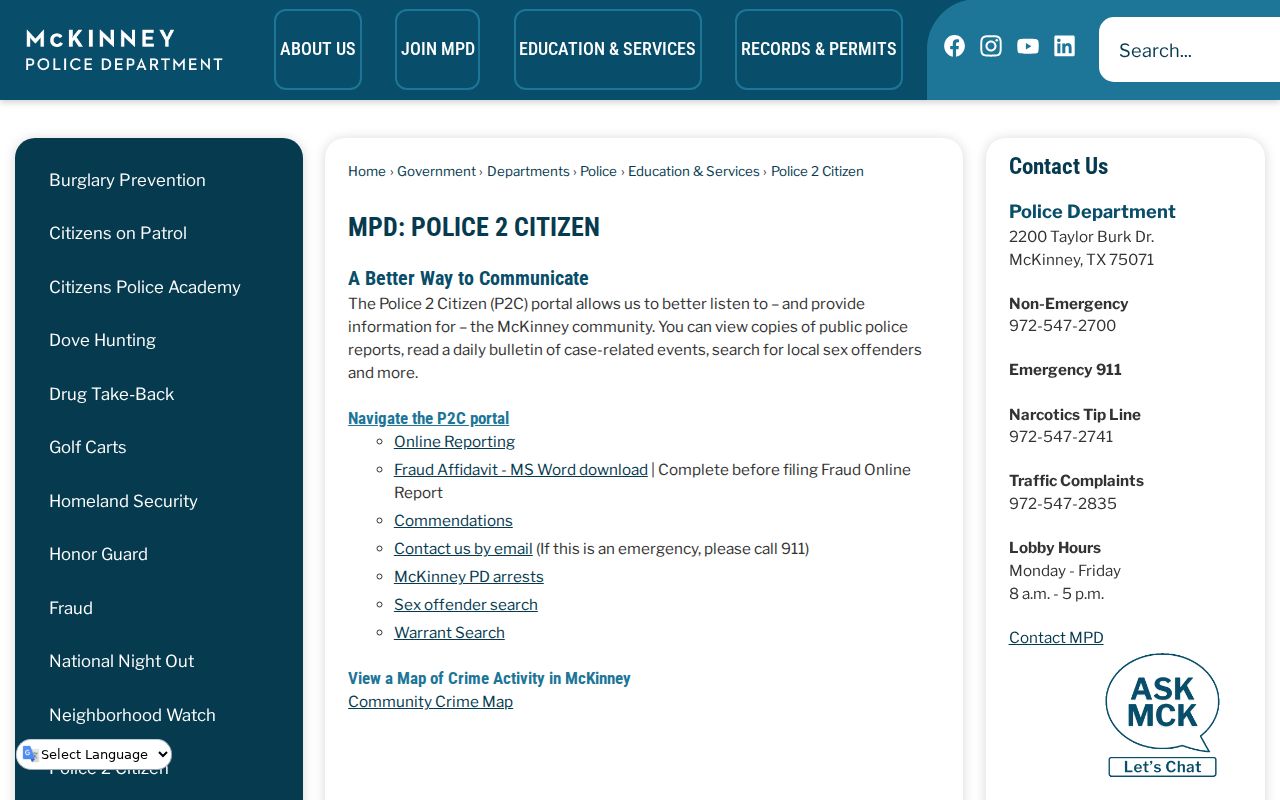
The portal makes McKinney unusually easy to start, yet its scope remains city police activity. It is not the Collin jail roster, a county court index, or a complete DPS criminal-history response.
The McKinney Police Department
McKinney Police holds records its officers create. The department is at 2200 Taylor Burk Drive, McKinney, Texas 75071. Its nonemergency line is 972-547-2700, and the published lobby hours are Monday through Friday, 8 a.m. to 5 p.m. Those city channels fit MPD reports. They do not replace a Collin clerk when prosecutors have filed a separate criminal case.
The MPD records route is also important when P2C does not display a report copy. Give the event or report number when known, the date and location, involved names, and a focused description of the document sought. Protected victim facts, juvenile data, an active-investigation portion, medical information, and other confidential details may be redacted or withheld.
The official McKinney Police page supplies this view of McKinney police operations:

The city building is the right physical anchor for MPD-created reports, while county-held records remain at the separate Bloomdale and Community Avenue campuses.
McKinney Criminal Record Tools Compared
P2C's public tools can look like one large McKinney search, but their time, record type, and legal meaning differ. Use the tab that matches the event before broadening the search.
| McKinney tool | Best use | Limit |
|---|---|---|
| Daily bulletin | Recent police activity by date | Activity does not always mean arrest |
| Arrest search | MPD arrest events | An arrest is not a conviction |
| Warrant search | Publicly displayed local warrants | An empty result cannot rule out every warrant |
| Public reports | Available copies tied to MPD events | Some reports or details require a request |
| Local registry | City-level registry information | The Texas DPS registry has statewide scope |
When a McKinney record appears in more than one tab, compare the McKinney incident number and date. Do not infer a final McKinney charge or court result from the police label alone.
Arrests and Bookings in McKinney
A McKinney arrest can create four connected records. MPD keeps the arrest or incident report. The Collin County Sheriff's Office keeps the booking and custody record if the person enters the county detention facility. A clerk opens a court file if prosecutors file a charge. DPS may receive fingerprint-linked arrest and later disposition data.
Search P2C first for McKinney event detail. Then use the official Collin inmate information route for current custody or releases within the past 24 hours and the Arrests and Releases Report for a period reaching back up to one week. After a McKinney filing, use the county case system. The booking charge can change after prosecutorial review, so later court records deserve more weight for the filed allegation and outcome.
Note: McKinney's city-only portal and Collin's booking tools are complementary records, not competing versions of one complete history.
McKinney Arrest Clearance Letters
MPD publishes a Local Arrest Records Check or Clearance Letter for a person reviewing what McKinney Police records show about that named person. The February 2026 form is local in scope. It does not certify the absence of arrests by another city, the county sheriff, another state agency, or agencies outside Texas. Incident and arrest report copies still require the proper open-record request.
The form calls for a physical, nonexpired government photo ID and in-person return. A request involving a minor needs added identity and relationship documents. The form also describes a notarized route for a person living more than 100 miles away, subject to its stated conditions. Treat the resulting letter as an MPD record check, not a statewide background check.
McKinney Municipal Court Records
McKinney Municipal Court is at 130 S. Chestnut Street, McKinney, Texas 75069, with a published phone number of 972-547-7676. Its hours are Monday through Wednesday and Friday from 8 a.m. to 4:30 p.m.; Thursday hours are 9 a.m. to 4:30 p.m. The court handles municipal and fine-only matters rather than felony or Class A and B misdemeanor prosecutions.
The official McKinney court appearance page says a continuance motion should identify the citation or cause number, defendant, setting date and time, and specific facts supporting the request. Those fields also show why a municipal record search benefits from the exact citation or cause number.
| Court Name | McKinney Municipal Court |
|---|---|
| Case Types Heard | City ordinances, traffic matters, and fine-only Class C misdemeanors |
| Case Lookup Channel | Municipal court clerk, city forms, and court appearance resources |
| What the Docket Shows | Citation or cause number, alleged offense, plea, settings, judgment, and compliance status where applicable |
| County Boundary | County Court at Law and District Court cases are held by Collin County clerks at Bloomdale |
McKinney Records on Two Campuses
McKinney is both the county seat and a city with its own police and court. That creates two city-located county records campuses in addition to municipal offices. The Collin County Courthouse at 2100 Bloomdale Road houses the District Clerk, County Court at Law clerks, felony district courts, county misdemeanor courts, District Attorney, magistration, and CSCD functions. The Sheriff's Office and Detention Facility at 4300 Community Avenue holds sheriff and detention operations.
Use Bloomdale for a filed McKinney felony or county misdemeanor. Use Community Avenue for McKinney booking, custody, sheriff reports, and sheriff warrant records. Use Taylor Burk Drive for MPD-created reports and Chestnut Street for fine-only McKinney municipal matters. The physical separation mirrors the legal split among McKinney record custodians.
The split also reflects McKinney's role in county history. Both Collin County and its seat were named for Collin McKinney, and the county's first District Court met in 1846. The old jail later became a Recorded Texas Historic Landmark. The Census QuickFacts estimates also document the city at 227,526 residents in 2024 and 236,001 in 2025. Today's Bloomdale and Community Avenue campuses replaced the compact courthouse-and-jail model with separate court, records, law-enforcement, and detention functions. A requester's destination now turns on the custodian, not merely on the fact that every office has a McKinney address.
The official McKinney court source provides this view of the McKinney municipal setting:
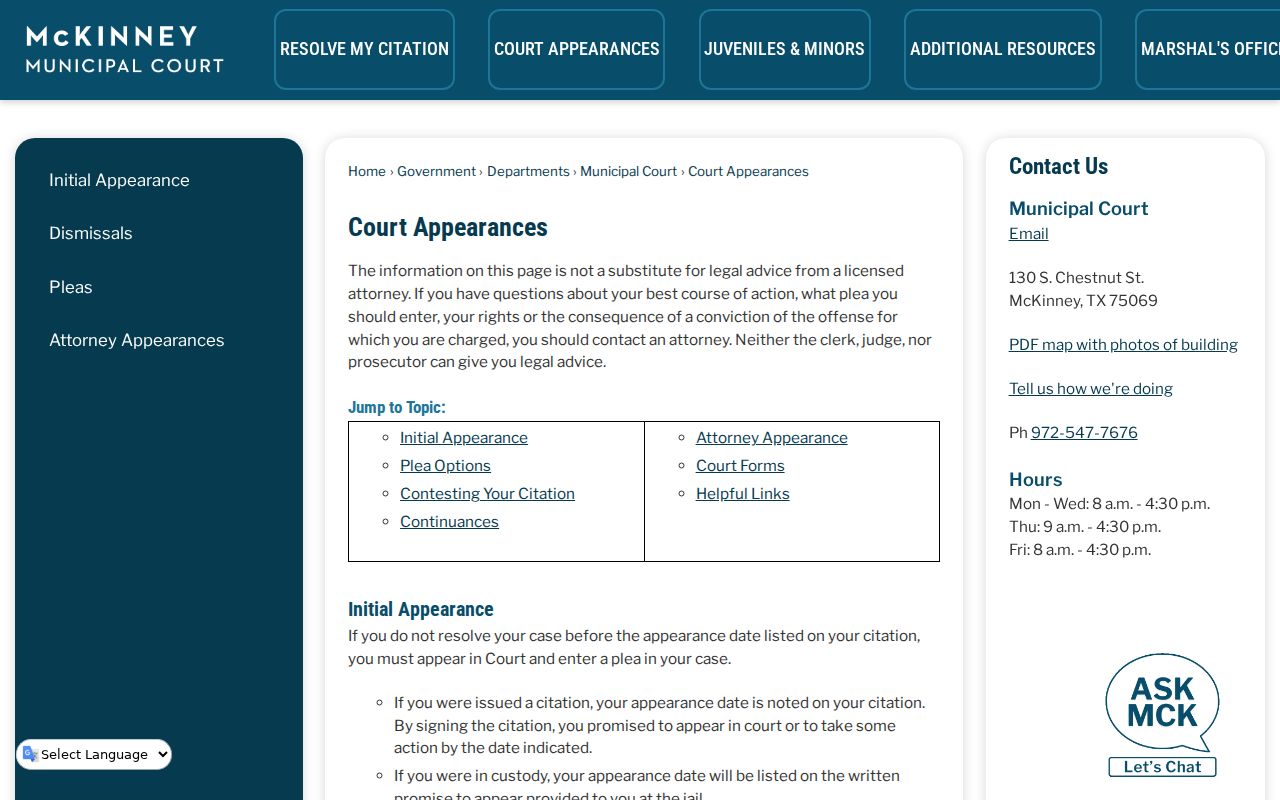
The court image marks the municipal layer, which should not be confused with county courts located elsewhere in McKinney.
Where McKinney Records End Up
McKinney provides the county's clearest city-to-county handoff. An MPD event begins in P2C or an MPD request. Custodial booking moves to the Collin jail system. A filed county charge moves to the proper Collin clerk. Qualifying arrest and disposition reports then feed the Texas Department of Public Safety Crime Records Division.
Record flow: McKinney Police Department › Collin County Courts › Texas Department of Public Safety
The DPS Crime Records Service public search is limited to convictions and deferred adjudications authorized for public dissemination. It is not a complete McKinney arrest list or a McKinney county docket search. For personal state-record review tied to identity, follow the DPS fingerprint process.
Missing McKinney Report Numbers
A missing report number does not end a McKinney records request. Start with the date, a narrow time window, location, type of event, and the names that can lawfully identify the incident. Review the P2C daily bulletin around the event date for a matching entry. If that still fails, send a focused request to MPD and state that the report number is unknown.
If the person entered county custody after a McKinney arrest, the booking date can help locate the Collin record. If a McKinney citation or court paper exists, use its court and cause number. The county case-information page explains which Collin search has the right scope and update schedule. Preserve each McKinney search term and response. Avoid asking an agency to research a broad life history. Public-information law requires access to existing records, not creation of an explanation or an answer to open-ended questions.
McKinney City Records Have Limits
A McKinney no-result screen is only a statement about that tool and query. P2C may omit restricted McKinney data. A new McKinney event may not yet have reached every system. A county prosecution may be easier to find by case number. Expunction, nondisclosure, juvenile confidentiality, and other restrictions can also affect public access.
- Police report
- The city agency's account of its response or investigation.
- Booking record
- The sheriff's intake and custody record at the county level.
- Municipal case
- A city court file for a fine-only matter within local jurisdiction.
- County case
- A filed felony or Class A or B misdemeanor held by a Collin clerk.
Compare scope before comparing results. The broader Collin County criminal court case search explains the county filing and docket layer without turning P2C into something it is not.
Public Access Rules
MPD records fall under the Texas Public Information Act, with exceptions for active cases and protected information. McKinney Municipal Court records are judicial records. They follow court rules, statutes, and common law rather than the standard executive-agency public-information process. Juvenile files, protected victim data, motor-vehicle details, medical facts, confidential sources, and sealed or expunged records may be withheld or restricted.
Key Statutes:
Texas Government Code Chapter 552 establishes access to public information and sets law-enforcement and privacy exceptions.
Texas Government Code Chapter 411 controls criminal-history dissemination and nondisclosure.
Texas Code of Criminal Procedure Chapter 55A governs expunction for qualifying Texas records.
A McKinney arrest is not a conviction, and a dismissal is not automatically an expunction. Verify the final filed McKinney charge and disposition with the court that owns the case. Match the MPD event number to the county cause number where both appear, since the police and court labels may differ after prosecutors screen the facts.